Where’s the Turkey?
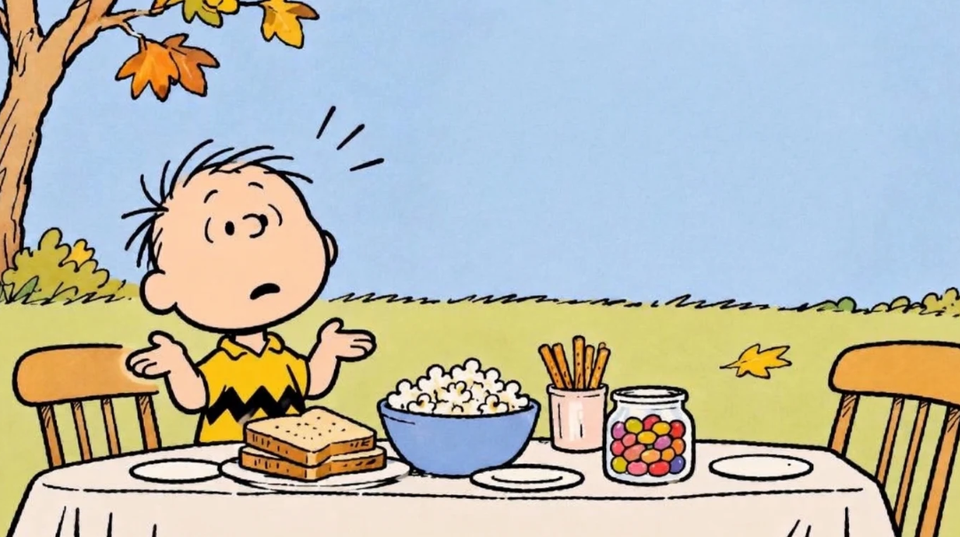
This morning, after getting up earlier than usual to let my dog out, I found myself watching A Charlie Brown Thanksgiving on Apple TV, enjoying a morning cup of coffee and, by chance, having a moment of inspiration to write a Tales of Product take on it.
I know, I know. It’s been a while since I last wrote one (my bad), but as the saying goes, "you get what you get, and you don’t get upset." Which, in a funny way, ties into the spirit of Thanksgiving.
Apparently, no one told Peppermint Patty aka Priscilla (who knew?), as Marcie calls her later.
For those who haven’t watched the Thanksgiving special in a while, Charlie Brown finds himself in the predicament of having to host Thanksgiving dinner after Priscilla invites herself and a few friends over.
With the help of Snoopy and Woodstock, he manages to put together a Thanksgiving dinner consisting of toast, popcorn, pretzel sticks, and jellybeans.
Priscilla is less than impressed.
Where’s the turkey? Where are the mashed potatoes? Where’s the cranberry sauce? Where’s the pumpkin pie?
And there it was. A perfect example of having expectations without ever having set them.
The Problem With Unspoken Expectations
Priscilla had a very clear picture of what Thanksgiving dinner should look like. Unfortunately, she never shared that picture with the people responsible for putting it together.
I think every Product Manager, at some point in their career, has had a Priscilla moment. I know I’ve had mine.
We have a vision of what a product or feature should look like, and somewhere along the way, we convince ourselves that everyone else shares that same vision. It’s not until we see what’s been delivered that we realize what was obvious to us wasn’t necessarily obvious to everyone else.
And our initial reaction? Where's the turkey?
The role of a Product Manager is to expose those differences in expectations early enough that something can be done about them.
That doesn’t mean we should expect Product Managers to anticipate every possible requirement. Discovering requirements is an iterative process, and sometimes seeing a working solution helps us uncover needs that weren’t apparent before.
There is, however, a difference between discovering something new and failing to communicate an expectation we already had.
Taking Ownership
What we do after having our Priscilla moment matters more than the moment itself.
It reminds me of a leadership principle that Jocko Willink and Leif Babin discuss in their book Extreme Ownership. One of the fundamental principles of leadership is taking ownership of the outcome rather than looking for someone else to blame.
As Product Managers, it’s easy to point to the development team for misunderstanding a requirement, the business for not providing enough information, or a stakeholder for not participating in a discussion.
But before pointing fingers, we should ask ourselves what we could have done differently.
Did we communicate our expectations clearly? Did we validate our assumptions? Did we establish a shared understanding of what success looked like?
Product Managers are often expected to lead people over whom they have no direct authority. That makes taking ownership even more important.
Taking ownership means recognizing our responsibility for creating the conditions in which others can succeed.
Eventually, Marcie reminds Priscilla (I just can’t let it go) that Charlie Brown never actually invited her to Thanksgiving dinner. It’s a moment that forces her to reflect on her own actions rather than the shortcomings of the dinner.
We could all use a Marcie in our professional lives. Someone willing to call us out when we're having our own Priscilla moment.
So don’t be a turkey. Say what you expect before you get to the dinner and give thanks to the teams that show up for you every day.
Happy Thanksgiving!
Spoiler. Snoopy and Woodstock did have a turkey 😄
Member discussion