The Phantom Nonsense
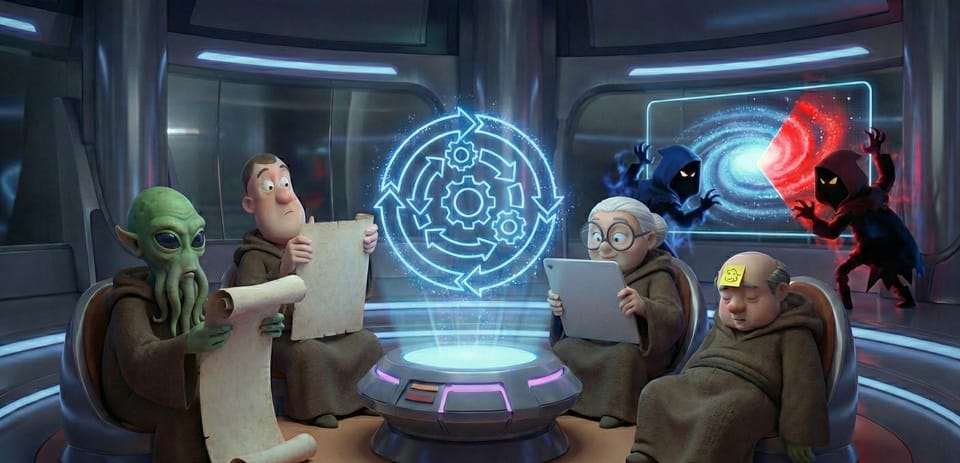
A long time ago on a Zoom call far, far away (well maybe last week).… a product debate broke out over whether the real issue was the project, the customer, or the fact that someone believed I did not fully understand the Agile Manifesto. There it was. The disturbance in the force. The moment the conversation stops being about solving a problem and starts being about defending a process.
Every product team knows this feeling. It sneaks in politely, usually wrapped in the phrase “best practice,” and suddenly the room is debating the purity of the framework rather than the needs of the user.
That is The Phantom Nonsense.
It is not a villain you can point to. Not a deadline or a stakeholder. It is something stranger: the belief that the process is the point. It convinces smart people that the framework is sacred and adaptation is betrayal.
In the real world, teams use whatever actually works. Sometimes that is Agile. Sometimes it is Agile-ish. Sometimes it is Waterfall, though ideally not while the galaxy burns :-) These frameworks started as reasonable attempts to help teams solve problems without losing their minds in process meetings. They were meant to make collaboration smoother, not create a new religion.
The moment you stop adapting, you drift into dogma.
Which brings us to the galaxy’s most famous case study in what happens when doctrine outruns reality.
The Jedi Council: Masters of Process, Novices of Adaptation
In the Star Wars prequels, the Jedi Council are the undisputed champions of ceremonial structure. They maintain centuries of codified rules. They meet often. They debate philosophy. They enforce guidelines so strict they could qualify as a compliance department.
If the Agile Manifesto existed in their universe, they would have engraved it on tablets and organized an annual summit to evaluate adherence.
And yet, their devotion to process blinds them.
- The Sith return unnoticed.
- The Senate falls to manipulation.
- Anakin spirals visibly, but protocol keeps everyone politely looking away.
The Jedi did everything their doctrine required and lost everything that mattered. They did not fall because of a lack of skill. They fell because they confused the framework for the mission.
I have seen product teams make the same mistake. Sprint ceremonies run with textbook precision. Standups timed like Olympic heats. Burndown charts that sparkle. Yet not a single meaningful outcome reaches the customer.
That is The Phantom Nonsense at work.
When Dogma Takes Over, Reality Slips Away
Frameworks are designed to help teams stay responsive and build better products faster. But when teams treat them as doctrine, they become the opposite: rigid, ceremony-focused, and slow to adapt.
Some problems demand iteration.
Some call for planning.
Some require stepping outside the playbook entirely.
But the Phantom Nonsense whispers that deviation is dangerous, that purity matters more than results. The Jedi obeyed that whisper. The galaxy burned anyway.
This Is a Way
The goal of product work is not compliance with a framework. It is solving a problem for a real human who will not care how elegant your sprint metrics look.
The true test of a team is simple:
- Does the framework serve the mission, or has the mission become serving the framework?
When teams choose flexibility over ritual, they navigate uncertainty with clarity. When they cling to doctrine, they build temples while the world collapses outside.
If the Jedi had paused long enough to ask, “What is actually happening, and do our methods still make sense?” the story might have gone differently.
Teams that ask the same question tend to deliver better outcomes.
The Phantom Nonsense survives only when no one questions it.
Once you shine a light on it, the force shifts back to where it belongs: the work itself.
Every framework promises the Way. Product work reminds us there’s always more than one path to the outcome that matters.