Product Science: “Is It Real? My Creation…I Do Not Know”
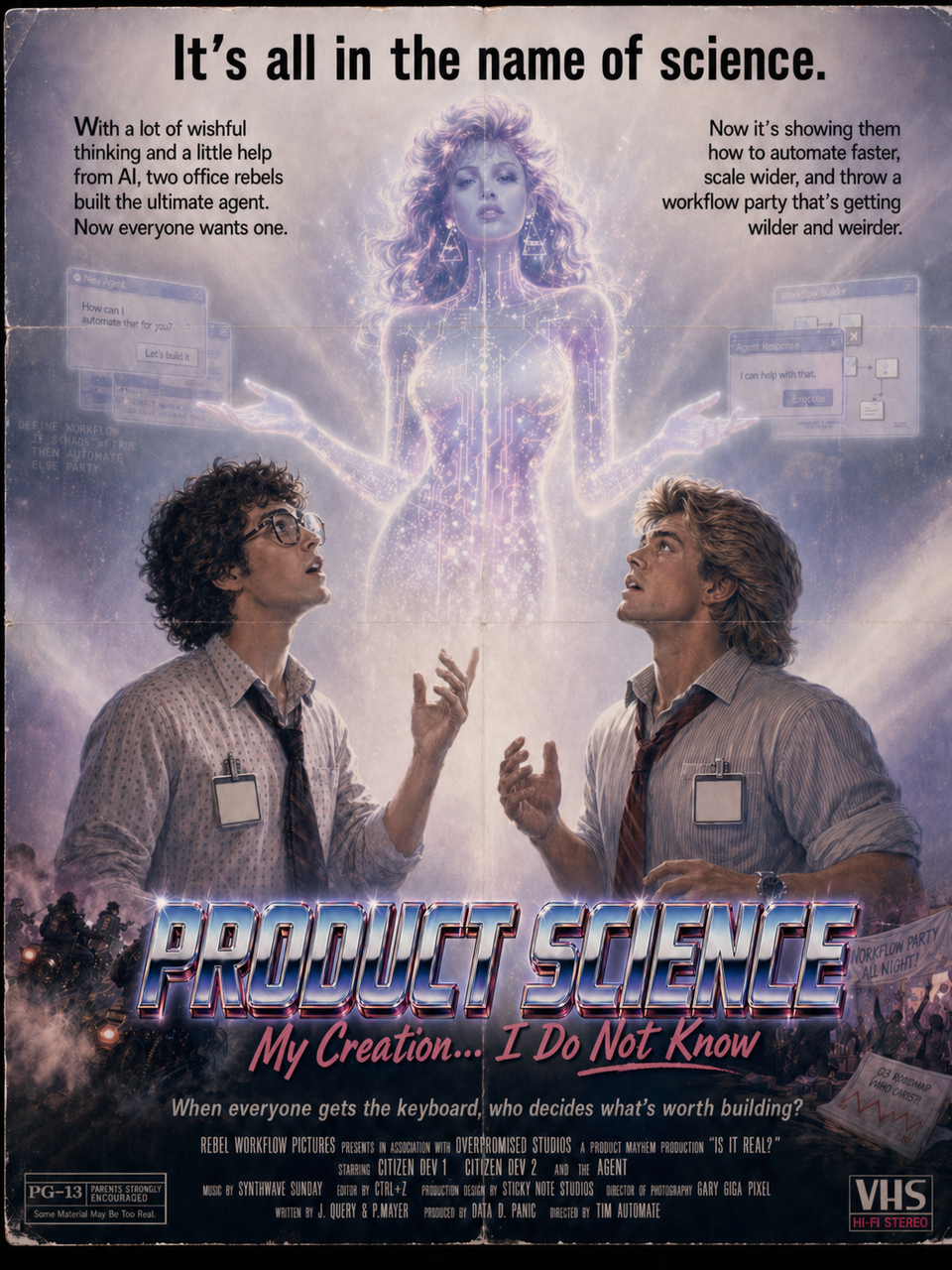
BlackRock’s AI transformation has a hint of Weird Science.
In 1985, two teenage boys sat in a bedroom, hooked a Barbie doll to a government mainframe, and built a woman.
No requirements doc. No discovery phase. No user research. Just Gary, Wyatt, and an absolutely unhinged idea executed with total conviction.
The result was Lisa. Brilliant, powerful, completely beyond their control, and almost immediately a problem.
That’s not a cautionary tale about technology. It’s a cautionary tale about building without judgment. And it’s exactly what’s about to play out at companies everywhere, starting with the largest asset manager on the planet.
BlackRock Is About to Hand Everyone the Keyboard
The Wall Street Journal recently ran a piece on BlackRock’s AI transformation. The headline detail: they built a platform called RockAI that lets non-technical employees spin up AI agents in minutes using natural language. No code required. Guardrails pre-baked. Safety built in. At least, that’s the promise.
They’re calling these employees “citizen developers.” The behavior they’re encouraging has a name too: vibe coding. In plain English, vibe coding means describing what you want in natural language and letting AI generate the working software or agent behind it.
The goal, stated plainly, is for people to automate large chunks of their own busywork and share those agents with colleagues.
BlackRock’s head of Aladdin Product Engineering put it plainly: AI will become the default mode for most processes. Research, coding, operations. Humans shift into smaller, cross-functional teams that oversee the work rather than do it themselves.
They started by rolling this out to 5,000 in-house developers. The plan is to go firmwide.
That’s a lot of Garys and Wyatts with a very powerful computer.
Lisa Worked Exactly as Designed
Gary and Wyatt got exactly what they asked for. The technology worked. Lisa was everything they asked for: smart, capable, almost supernaturally effective at solving problems.
The chaos wasn’t a malfunction. It was the output of two people who built to a fantasy instead of a need. They never asked what problem they were solving. They never defined what “done” looked like. They built what they wanted and hoped the rest would sort itself out.
Removing the engineering bottleneck does democratize problem-solving. People closest to the pain get to build the fix. The RockAI bet is a reasonable one.
But here’s what the platform can’t do: it can’t tell anyone whether the thing they’re building is worth building.
That’s not a technology problem. It never was.
Bits and Pieces and......Creation
Citizen development changes where software ideas come from.
Instead of waiting for a central product or engineering team to prioritize every request, the people closest to the friction can start building their own fixes. That is powerful. It is also where things get complicated.
People rarely build from a neutral view of the system. They build from the part of the system that annoys them the most.
They’ll build to their own bottlenecks, their own workarounds, their own definitions of what “better” means. Individually, each of those agents might be perfectly reasonable. The problem is nobody’s looking at the system.
You end up with forty agents automating forty slightly different versions of the same workflow, each one built around a local workaround that made sense in the moment.
That is when the party gets out of hand. The workaround becomes the workflow. The workflow becomes the standard. Suddenly someone has to explain why there are motorcycles in the living room.
BlackRock’s guardrails are smart. Building safety into the platform before rolling it out to non-technical users is the right call. But structural guardrails aren’t strategic ones.
A guardrail stops you from building something dangerous. It doesn’t stop you from building something useless, redundant, or focused on solving the wrong problem.
What the PM Actually Does Now
This is the part where I’m supposed to tell you the PM job is in danger.
That’s not where this is going.
The PM job in a citizen developer world is more important than it’s ever been. It’s just different.
Your value was never gatekeeping access to engineering. If that’s where you built your identity, this moment is going to be uncomfortable. But if you were doing the actual work of figuring out what’s worth building, you’ve never been more necessary.
RockAI can’t look across thirty locally built agents and notice they’re solving the wrong problem. It can’t ask why this agent exists, who it actually serves, or what success looks like. It can’t hold the thread between what people want to build and what the business actually needs.
That has always been the job.
You’re not the engineer. You’re not the citizen developer. You’re the one who notices the motorcycles in the living room before the party becomes the process.
Don’t Stop the Experiment. Productize It.
The answer is not to smother citizen development with a fourteen-step approval process. That would turn transformation into a DMV line with better branding.
The better move is lightweight product governance.
Not bureaucracy. Not theater. Not a committee that meets every other Thursday to admire a spreadsheet.
Governance means giving citizen-built agents a clear path from local experiment to scaled capability. It means asking a few basic product questions before the organization wakes up surrounded by duplicate workflows and half-owned automations.
What problem does this agent solve?
Who owns it?
Who uses it?
What system does it touch?
How will we know whether it works?
Does something like this already exist?
Should this stay local, or does it belong in the enterprise toolkit?
That last question matters. Not every agent needs to become a platform capability. Some should remain local tools. Some should be retired. Some should be merged. Some should be promoted, hardened, monitored, and treated like real products.
This is where product management becomes less about managing a backlog and more about managing a living ecosystem of capabilities. The PM is the one who decides which experiments are worth keeping.
The House Is Full of Bikers. Now What?
The citizen developer wave is coming whether organizations are ready or not. RockAI is one version of it. There will be many others.
At first, it will feel like magic. People building things. Shipping things. Automating things. The backlog will look less like a mountain and more like a buffet.
Then the harder question shows up:
Does any of this actually matter?
That is where product judgment earns its keep. Not by blocking citizen developers, but by giving their work a strategy, a shape, and a reason to exist.
Your AI agents won’t have motives. They’ll just do what they were built to do.
The only thing standing between a real outcome and a house full of bikers is someone who knew why they were building it in the first place.
Gary and Wyatt got lucky. Lisa turned out to be benevolent. She wanted to help, even when things got out of hand.
Don’t build your product strategy around getting lucky with Lisa.
Member discussion