Bang! Zoom! To the Moon
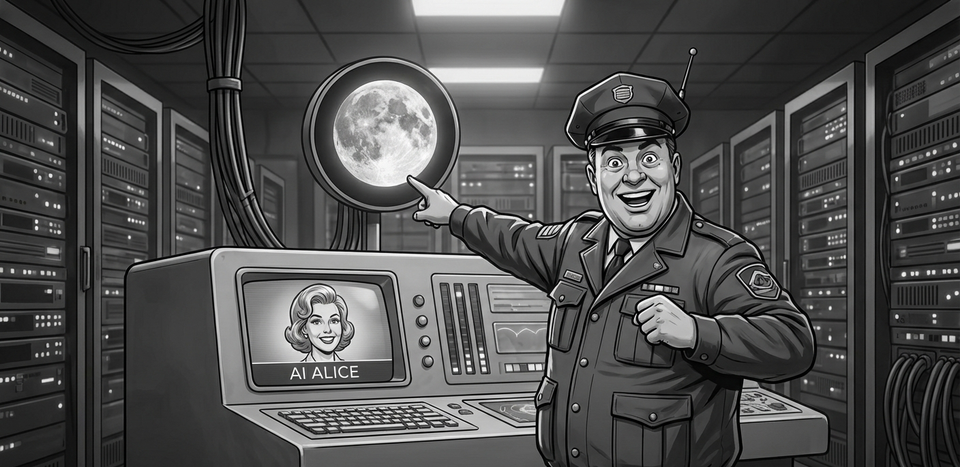
On a streaming service, in an alternative universe, The Honeymooners is just starting.
Ralph Kramden storms into the data center control room with an electric bill in his hand.
He looks at the wall of monitors.
Then back at the bill.
“No. That’s impossible.”
He shakes the paper once, like it might straighten itself out.
“This says we used how much power?”
The console lights up.
AI Alice: “That figure is correct, Ralph.”
Ralph stares at the screen.
“Correct?”
He looks back at the bill.
“Correct?”
He throws his hands up.
“This place is usin’ more juice than the Brooklyn bus depot!”
AI Alice: “Cooling systems account for most of the increase.”
Ralph squints.
“So the machines get hot?”
AI Alice: “Yes.”
“…so you cool the machines?”
AI Alice: “Correct.”
“…so you use more power?”
AI Alice: “Yes.”
“…which makes the machines hotter?”
AI Alice: “That is an accurate summary.”
Ralph closes his eyes.
“How long we got?”
AI Alice: “Eighteen months.”
Ralph’s eyes snap open.
“Eighteen months?! Why I oughta—”
He stops.
“Eighteen months?”
AI Alice: “Energy costs will become the dominant constraint before then.”
Ralph looks at the bill.
Then up.
“One of these days?”
He points.
“Bang! Zoom! To the moon!”
AI Alice: “A lunar environment would reduce cooling requirements.”
Ralph freezes.
His finger still pointing upward.
He slowly lowers his hand.
“Wait a minute…”
He looks at the console.
“See? She gets it.”
Meanwhile in our timeline….
Google looked at the same problem everyone else is trying to solve: rising energy costs, cooling requirements, and infrastructure constraints.
Then they asked a different question.
Not: How do we optimize within these limits? But: Where do these limits not exist?
That's usually the question you ask when the old answers stop working.
That question didn't stay abstract for long.
The result is Project Suncatcher, an ambitious research effort exploring what AI infrastructure might look like beyond Earth.
It reads like a page from a sci-fi novel. Solar-powered satellites carrying AI chips, flying in tight formation, connected by optical links. Operating in an orbit with near-constant sunlight.
The paper lays out some numbers that are hard to ignore.
The Sun generates more power than 100 trillion times humanity's total electricity production. Solar panels in the right orbit can be up to eight times more productive than on Earth. Continuous exposure. No weather. No grid competition.
And the vacuum of space? Free cooling.
They tested their chips against radiation exposure. Better results than expected.
They modeled satellites flying just hundreds of meters apart to maintain optical connections. They analyzed orbital dynamics. They ran projections on launch costs.
Crazy? Maybe not. If launch costs continue their trajectory, space-based infrastructure might cost roughly the same per kilowatt as it does on earth.
Except with better power. Better cooling. And nobody is asking about their electric bills.
How's that for innovation?
Back to our regularly scheduled program…
Later, Ralph pauses at the door.
“So lemme get this straight.”
He turns back.
“We can put a computer on the moon, but we can’t keep the lights on in Jersey?”
AI Alice: “The moon would solve the cooling problem. Nobody is asking about their electric bills on the moon.”
Ralph nods.
“See? That’s why the moon makes sense.”
He walks over to the console.
Taps the monitor twice.
“Baby, you’re the greatest.”
AI Alice: “Thank you, Ralph.”
Ralph opens the door.
Leans into the hallway.
“NORTON!”
“Get down here! We gotta plan a moon launch!”
You can learn more about Project Suncatcher here: https://research.google/blog/exploring-a-space-based-scalable-ai-infrastructure-system-design/